What to do in Hakone: our ultimate bucket-list as repeat visitors!

Updated: Aug 22
Before we ever went to Hakone, I had heard of it only as an onsen resort that was a favourite destination among Japanese friends for a relaxing getaway. Now, I love onsen as much as the next person but, when a friend suggested a weekend break, I was skeptical about filling a whole two days. How wrong I was: we didn't have time to even skim the surface that first trip, so we've been back again and always discover something new. Here are our suggestions for what to do and see in Hakone. We have pinned them all for you on our free Hakone map.
Disclosure: This post contains affiliate links. If you click through and make a purchase, we may earn a small commission, ♡ at no extra cost to you ♡ It helps cover the costs of keeping this site alive and we really appreciate your support
*Any prices quoted below are subject to change
Hakone onsen & spa experiences
So, this is really what Hakone is famous for and what at least Japanese tourists get excited about.
Hakone's public onsen (for day-visitors)
Thanks to Hakone's volcanic activity, there's such a huge choice, but most are in the Yumoto or Gora areas. Tenseien and Hakone no Yu are both foreigner-friendly, but we really like Tenzan because, for us, it rates for atmosphere.
Hakone ryokan with private onsen
If budget and time allows, an overnight stay with kaiseki dinner and a private onsen is Hakone's signature experience. Since public onsen are usually segregated by gender and many in Hakone have a strict no-tattoo policy, a private onsen will mean you get to soak as a couple or family, ink or no ink. Have a look at our where to stay in Hakone guide, since choosing your hub will make a big difference to your stay in Hakone, and then check out what's available for your dates on booking.com.
(Free) foot baths (ashiyu)
If you're not sure about going all-in (literally), you can get a taste of onsen life in Hakone at one of the foot baths scattered around the area. There's a free one at Souzan observation platform at the ropeway station and another at Shoganji temple in Yumoto. Don't forget to bring your own towel to dry off afterwards. There are also a few cafés with ashiyu, where you can soak your extremities while enjoying a nice matcha latte and a slice of cake. Try Bakery&Table in Moto-Hakone or Naraya Café at Miyanoshita station.
Hakone nature & (Mount Fuji) views
Hakone's stunning mountain setting means great views and plenty of nature, whether you want to enjoy it actively or passively.
Komagatake Ropeway & Ashinosora observation deck
Take a 7-minute ride from Hakone-en down by the lake up to the peak of Mount Komagatake for what we think are possibly the best views in Hakone. Return tickets are around 2200 yen for adults and secondary-school kids, 1100 for primary-school kids (not covered by the Hakone Freepass). The newly renovated Ashinosora observation deck at the top of the ropeway (hard to find on Google maps because it's only marked in kanji - we've marked it on our Hakone map though) has a "floating platform" and a big Fuji "photo frame". You might even be able to pick out Tokyo Skytree on a fine day - the views are that good.

Hakone Ropeway
This is the other, longer ropeway in Hakone. 15 minutes or so will take you from the lakeside terminal up over the volcanic fields of Owakudani to the upper terminal of Souzan (where you can enjoy a free hot-spring footbath - see above). You can expect stunning views - when the weather is good - but the ropeway is also an integral part of the public transport system in Hakone and connects to the cable car that will take you up to the museums and other attractions in the Gora area. The ropeway (and cable car) are included in the Hakone FreePass. It's important to check beforehand if the ropeway is in service, since it is subject to weather (especially high winds) and can also close in cases of high volcanic activity in Owakudani.
Day hikes around Mt. Hakone
Trails range from 30 minutes to 5+ hours. The circuit walk along the caldera rim is iconic; easier alternatives include the boardwalk trails around Lake Ashi or the forest paths from Gora. One popular destination is Chisudani Falls, which involves a 30-minute hike from Kowakidani Station or, if you have more time on your hands, a 15km round hike from Yumoto (gorgeous in the autumn). An alternative for day-trippers and history fans: walk in the footsteps of samurai along a section of the old Tokaido road, the ancient route between Edo and Kyoto at the bottom of Lake Ashi.

Mt Fuji swing
This is one of our real insider tips, since it's a spot in Hakone that not very many people know about, and is an alternative to the massively popular Fuji Sky Swing in Kawaguchiko that you typically have to queue for ages for. We're not gonna lie: it's not easy to get to and you're going to need a car or a taxi (check it out on our Hakone map). But we were there in October, there wasn't another soul around, we didn't even have to pay (I think you do have to pay a small fee usually) and the views were fabulous.

Sengokuhara susuki grass fields
You mightn't think a field is necessarily worth visiting but our taxi driver pointed the Sengokuhara fields out to us as one of the most popular destinations in Hakone, apparently amongst couples especially. Long romantic walks, I suppose. In any case, this is a huge expanse of pampas grass that sways and shimmers in the wind and is especially lovely in autumn. There's a little path leading through the middle of it: solitude is by no means guaranteed, but it is indeed a lovely spot. If you can time it for the late afternoon, the low sun over the pampas is spectacular. And it's free!
Mount Fuji "perfect" viewing point
Described as the perfect viewing point on Google maps, this is where you'll get those views of the lake, the mountains, the red torii of Hakone Shrine, the pirate ships and Mount Fuji (if you're lucky with the weather) all in one. And it's also free!
Hakone museums, temples & cultural sites
If your mind is more on enjoying the natural beauty of this part of Japan and soaking your tired muscles to a pleasant jellified state, Hakone's museums and cultural sites are possibly not really on your radar, but here are a few that we recommend.
Picasso Pavilion
This striking white building inside the Hakone Open-Air Museum has a collection of over 300 pieces by Picasso, a large proportion of which are ceramics, making it the largest collection in Asia.

Hakone Shrine
So, you'll already know the crimson torii in the water of Lake Ashi from at least 50% of every photo you've ever seen of Hakone, but, as you probably know, the torii is just the gateway to the shrine and Hakone shrine itself is up at the top of the flights of mossy steps you can see from the lakeshore. The shrine buildings are an unusual pinkish-red colour but it's the setting that really makes this place worth visiting. Allow yourself enough time to explore the side paths between the shoreline and the shrine, with their stone lanterns, little curved bridges and shady staircases. There are several other torii to discover, for example, and a boathouse. This will come as no surprise but you should visit the waterside torii early in the morning or in the (very) late afternoon. I've been there at 7am and the tranquility was beautiful but even then I wasn't the only one there. On the other hand, I've driven past in the afternoon and the tourists were queued several persons deep the whole 25 metres back to the road, waiting for their 30-second Instagram photoshoot.
Pola Museum of Art
You don't have to be an art lover to appreciate this place. Although the exhibition is very impressive indeed, including several works by Monet, van Gogh, Renoir, Cézanne, Chagall, Dalí, and a superb collection of pieces by modern Japanese artists, the building itself - looking like a steel and glass spaceship parked in the middle of the forest - is a jaw-dropping space. Absolutely worth dropping by, although it is a little out of the way. Klook has a private guided tour for up to 8 people in a chartered vehicle from Tokyo to the Pola Museum of Art, the Venetian Glass Museum and the Hakone Open-Air Museum, saving you time and transport headaches if Hakone's three most popular museums are on your bucket-list.
Sotoshuryukozanchoan temple
Also known as Choanji to its friends, this small Buddhist temple is one of Hakone's favourite autumn-leaf viewing spots but is wonderfully atmospheric in every season and is known for its over 200 stone "rakan" statues scattered throughout the grounds, all with different amusing poses and expressions. Could make a fun "rakan rally" for the kids. There's also an extensive cemetery and a koi pond.
Narukawa Art Museum
This small but perfectly formed museum doesn't catch the eye of many tourists but they don't know what they are missing out on. It has a wonderful collection of nihonga art and a permanent exhibition of Chinese jade sculpture that are worth the approx. 1500 yen entrance fee alone. But the museum also has one of the best views of Mount Fuji over the lake from its café and panorama viewing area.
Old Tokaido Road
I mentioned the Old Tokaido Road above as a potential hiking route but, since you don't have to make much of an effort to get there and it's historically interesting (it is possibly the most famous road in Japan, connecting Edo and Kyoto in the Edo period - sort of the samurai Route 66, if you will), it's worth having a look. There's not much to see - it was just a road after all, a a relatively primitive one at that - but the original centuries-old cobbled paving still survives in places and the super-tall cedar trees lining the road will make you feel like you're on the set of "Shogun".
Hakone Amazake Tea House
The Amazake Tea House is over 400 years old and for much of that time served merchants, samurai and noblemen travelling up and down the Old Tokaido Road. If it hadn't been for our taxi driver pointing this place out, we would have driven on past, but it is stepped in history and still serves the sort of treats it would have been serving in the Edo period. As the name suggests, amazake is the star of the menu - it's a naturally sweet drink made of fermented rice and is supposed to be very healthy. It's traditionally served hot, but they have a chilled version here too.
Hakone gardens and parks

Hakone Museum of Art
You're probably asking yourself why I've put an art museum under "Gardens and Parks" but that's because this little museum honestly has one of the most beautiful gardens I have seen in Japan (see pic above). It's small but exquisite - it sounds like a cliché but we genuinely saw gardeners at work trimming the grass with nail scissors. We were there in early July, when everything was stunningly green and the hydrangeas were in bloom, but I can imagine how gorgeous this place must be in other seasons too. There's a cute little (modern) teahouse serving matcha and traditional Japanese sweets. There weren't more than maybe 3 other visitors there at the time. I guess, like us, nobody would every guess there was such a beautiful garden here.
Hakone Gora Nettai Botanical Gardens
Hakone Gorakoen gardens is included in the Hakone Freepass and not far from Gora Station at the head of the cable car line and the Hakone Tozan train line, and makes a nice diversion if you happen to be in the area anyway. It has a lovely fountain in the middle, tropical greenhouses and is especially famous for its roses. There are also several activities - glassblowing, pottery, glass beads workshop, tea ceremony, etc. - that you can do up here. Around 650 yen for over 12s.

Hotel de Yama
Hotel de Yama is our favourite place to stay in Hakone but even if you're not a guest, the garden is worth a visit, especially in mid-April through early May, when the azaleas are in bloom. We've yet to see it at that time of year but can confirm that it's lovely at any time of year, with its manicured bushes and tall, spindly cedar trees making a perfect foreground for views of Mount Fuji. And it's just around 400 metres up the road from the Heiwa-no-torii at the water's edge.
Family-friendly activities in Hakone
Our kids love Hakone, and there's plenty to keep children of all ages busy, whatever the weather. One note, though, if you're taking a water-baby or two with you: swimming is not premitted in Lake Ashi, as tempting as it looks on a hot summer's day.
Lake Ashi Aquarium
This is part of the Hakone-en complex at the bottom end of the Komagatake Ropeway. Small but engaging, with lake fish and touch pools and very cute otters and seals. You'll find better aquariums up in Tokyo or elsewhere but, if you're stuck for something to do on a rainy afternoon, this will entertain the kids for an hour or two. There's also a little petting zoo nearby and a dock for amphibian-vehicle lake cruises.

How kid-friendly this place is came as a complete surprise to me and we loved it. There's a cool maze, the Knitted Wonder Space2 (a sort of climbing net), giant fried eggs to lie on and a whole lot of colourful, fun outdoor sculptures that are a brilliant introduction to art. There's also a good all-you-can-eat restaurant with a huge selection of food and drink for even the pickiest of eaters.

Owakudani
We don't see many of these volcanic fields in Europe, so it's a bit of a thrill to see them up close like at Owakudani and taking the cable up and over them is part of the fun. Then, of course, you get to eat one of the curious-looking black eggs (they taste just like regular eggs). Just a quick note: the weather is quite changeable up here and can get be a lot cooler and breezier than down at the lakeside. We were there in summer and were admiring the amazing views under blue skies; 10 minutes later clouds had rolled in right on top of us and you couldn't see a thing! Make sure you have an extra layer with you for the kids, just in case.
Lake Ashi boat tour
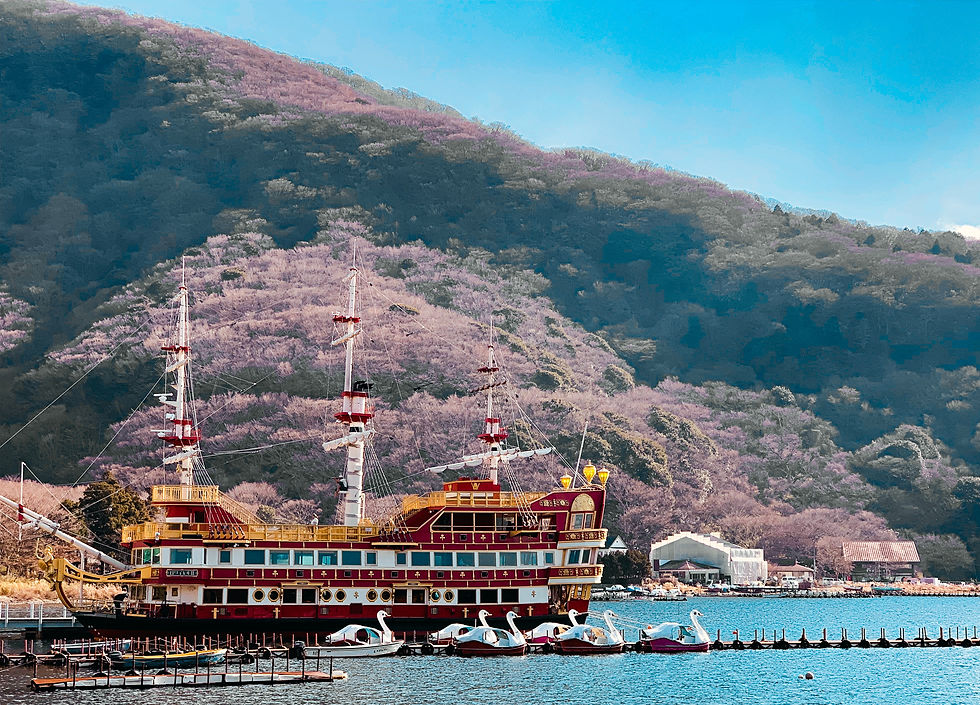
Have you even been to Hakone if you don't cruise the lake on one of the pirate ships? The fare is covered by the Hakone Freepass (although you can pay more for VIP seats up front). If it's really too kitschy for you, there are regular boats too and even speedboat tours.
Yunessun onsen water park
This place describes itself as an "onsen amusement park". You know how most onsen are segregated into male and female baths and you have to get naked? Well, this is an onsen resort where you can enjoy the hot springs as a family and wear a swimsuit. There is a small indoor swimming pool, too, water slides, baby pools, etc. Yunessun is part of the Ten-Yu onsen complex, with beautiful outdoor onsen for adults too.
Melody Road
You're going to need a car/taxi for this one and it's not something you have to go out of your way for, but our kids got a kick out of it. It's a section of road (actually called "Melody Pave" in Japanese) that plays a tune when you drive over it at a certain speed. I believe it was originally conceived as a way of keeping drivers within the speed limit and it mightn't be unique to Japan, but I've never come across anything like it in Europe.
So, there you have it. 25 ideas for what to see and do in Hakone - you can see why staying for a night or two is a good idea. For a day trip to Hakone from Tokyo, you're best to limit your bucket-list to a maximum of three attractions or organise a private tour to cut down on transport time.
Planning your trip to Hakone? Check out our other Hakone posts:
Our hub post is your quick and easy intro guide to Hakone
Wondering if you're going to need a car for Hakone? Our Hakone transportation guide sets out all of the public transport options
With so much to see and do in Hakone, staying overnight is always a good idea but accommodation is very spread out. Our Hakone accommodation guide explains where the best spots to stay are.
Just in case you're undecided: here's why we think a trip to Hakone is definitely worth it but why some visitors may want to save it for next time
If you haven't got the time for an overnight stay, our itinerary for a 1-day trip to Hakone from Tokyo will help you make the most of a quick visit
One of the highlights in Hakone, read our guide to the Hakone Open-Air Museum to decide if you should include a visit on your trip to Hakone
And here are, in our opinion and experience, the best times of the year to visit Hakone

Collecting your Japan trip inspo on Pinterest? Hover over and click this pin to save it to your board
Want us to plan a Japan trip just for you? Need help putting together your first trip to Japan? Just get in touch.


Comments