Hakone day trip from Tokyo: 1-day itinerary (Hakone loop) and how to get there

Updated: Sep 27

That Hakone is one of the most rewarding day trips from Tokyo is a hill we're ready to die on and, although we love the place (and onsen life!) so much that we've stayed overnight the last few times, we honestly believe that it's a day of your Japan trip well invested. You've got a lot of options, though, so here's our guide to planning your Hakone day trip, including transport where to eat and what to see and do.
Disclosure: This post contains affiliate links. If you click through and make a purchase, we may earn a small commission, ♡ at no extra cost to you ♡ It helps cover the costs of keeping this site alive and we really appreciate your support
*Any prices quoted below are subject to change
Is a Hakone day trip from Tokyo worth it?
If you can spare a day in your Japan itinerary, Hakone is a great change of scenery (literally!) from the rush and big lights of Tokyo. This is a beautiful part of the country - lakes, mountains, Fuji views, forest trails and hot springs - and, although you'll have to be realistic about how much you can see and do in one day, it's definitely worth the effort. The train from Shinjuku takes around 2 hours, so if you can get an early start in, you'll have plenty of time to see the highlights. In a few cases, we would recommend putting off a trip to Hakone until you can dedicate more time or have better weather. Have a look at our other Hakone articles where we discuss the best times of the year to visit Hakone and whether a day trip from Tokyo is always worth it.
How to get from Tokyo to Hakone - your options compared
Odakyu Romancecar Tokyo to Hakone (most direct)
The Romancecar is a bit like a mini Shinkansen: not just as fast but roomy and you get reserved seats. One advantage is that it takes you all the way to Hakone-Yumoto (and the start of the Hakone loop) without changing. It takes about 1 hour 45 minutes and costs about 2470 yen one way.
Tokyo to Hakone bullet train (fastest)
Taking the Shinkansen from Tokyo to Hakone is the fastest option but is also the most expensive. It takes around 33 minutes from Tokyo Station to Odawara (around 4000 yen), but you'll have to change there to a local train or bus to get you into Hakone anyway, so that cuts into your time savings a little. I'd really only advise taking the Shinkansen if you have a JR Rail Pass, either a regional or all-Japan one, that you want to use.
Regular Tokyo to Hakone train (cheapest)
And by regular trains, I mean ones without reserved seating, making them the cheapest option and not necessarily the slowest (although they can be crowded, of course). Odakyu is the best option from western Tokyo (Odakyu's Shinjuku Station or Yoyogi-Uehara Station). The Express service takes around an hour and 20 minutes as far as Odawara and costs about 1000 yen. The regular Odakyu trains are included in the Hakone FreePass. From eastern Tokyo, the best option is the JR Tokaido line from Tokyo, Shimbashi or Shinagawa Stations, costing around 1600 yen and also taking about 1 hour 20 minutes to Odawara. In both cases, you'll then have to make your way to Hakone proper from Odawara, by bus or local train (Hakonetozan line).
Highway bus (slow and kinda expensive tbh)
The highway bus is another option, but one I can't really recommend. The journey from Shinjuku Busta bus station to Hakone takes well over 2 hours and is very dependent on traffic conditions. The coaches take a westerly route and arrive into Hakone via Gotemba, with stops in the Sengokuhara area before travelling on down to stop at Hakone-en. Since the tickets, at around 2700 yen one way, are not especially competitive compared to the trains and the bus is a lot slower, the only reason I can think of for taking the bus is if you want to go shopping in Gotemba and want to combine that with just one or two attractions in the Sengokuhara area.
Guided/private tour from Tokyo to Hakone
Especially if you're travelling as a group, a tour from Tokyo is an excellent option in our opinion, since it won't cost soooo much more than the return train fare plus the cost of public transport/taxis within the Hakone area and it saves a lot of time - if you've read or post on getting around Hakone you'll know that the public transport system is well-developed but frequency is not what you're used to in Tokyo, especially at off-peak times of year.
Here, too, you have several options. The first option is booking a spot on an organised (bus) tour, generally with either Shinjuku or Tokyo as a starting point. They are usually around 10 hours long and include the top 3 or 4 highlights of any Hakone trip (Lake Ashi, Owakudani, Hakone Shrine), so are great for first-timers. Many of them combine the top attractions of Hakone with one or two attractions in the Fuji 5 Lakes area, like Oshino Hakkai or the Chureito Pagoda, which are time-consuming to get to from Hakone by public transport, so are an added bonus of a guided tour.
The downside of an organised tour is that you have little flexibility and might have no chance to visit something your really wanted to see... or might not have as much time as you want. This is where a private tour shines. You'll have a driver pick you up at your hotel in Tokyo and drive you around to whatever attractions you want before delivering you back to Tokyo after a hard day's sightseeing. A private tour is more expensive per person but maybe not as expensive as you think, and they are completely customisable. We've done this sort of tour twice now in Hakone and really appreciated being able to see what we wanted to see, spend the amount of time we wanted in each location
Check out these organised and private tours to Hakone from Tokyo on Klook, Viator, and GetYourGuide.
Hakone Loop - itinerary for a day trip from Tokyo
The first thing I suggest is leaving Tokyo as early as you can bear. The first Odakyu Express trains leave just before 5:30 am and get you into Odawara at around 7am. The first trains on the JR Tokaido line to Odawara leave at around 6:15 am, arriving at around 7:40 am. If this sounds like torture, just remember that Hakone is an area rather than just one little town and it's easy to underestimate the time it takes to travel between the various attractions. You don't want to have to strike something from your list of must-sees just because you didn't have enough time in the end. Plus, early morning is the best time to see Mount Fuji and everything is much less crowded.
Hakone loop itinerary
The classic Hakone one-day itinerary is called the "loop" because you hit the top attractions in the area travelling around in a circle starting from Odawara or Yumoto. We planned the following itinerary to tick off what we would suggest first-timers in Hakone see and do while being realistic about timing. Have a look at our Hakone attractions bucket-list for more ideas; we have also marked everything on a map for you.
Since you're going round in a loop anyway, you could go clockwise or anti-clockwise, but we recommend going clockwise (as set out below), because the best time get those Fuji views across the lake are in the early AM and it's best to hit Hakone shrine for those those iconic torii shots first thing in the morning too. If you are going rogue and plump for the anti-clockwise route, remember that the pirate ships take longer on the way back down the lake, since they take a more westerly route and stop at Hakonemachi-ko before returning to Motohakone-ko.

Odawara/Yumoto to Hakone Shrine
From Odawara or Hakone-Yumoto (if you've taken the RomanceCar), take the bus (Z03, for example) to Motohakone. When you get out of the bus, walk down towards the lake and take right down Jinja-Dori-Street. If you want, you can walk along the edge of the lake instead of Jinja-Dori-Street but you'll miss out on the big torii on the way. Walk right around until you come to the little path on the left that takes you down to Heiwa-no-torii, the iconic waterside shrine gates that you see in practically every photo of Lake Ashi. While you are down at the lakeside, you can take a short 20 metre detour to the left to the boat storage at Hakone shrine, where there is a gorgeous red bridge for another photo op. Head back to the Heiwa-no-torii and back up the steps to the road then further up to Hakone Shrine itself. This stage of the journey will take around 2 hours, depending on how long you spend at Hakone shrine.
Hakone Shrine to Togendai Port at the top of the lake
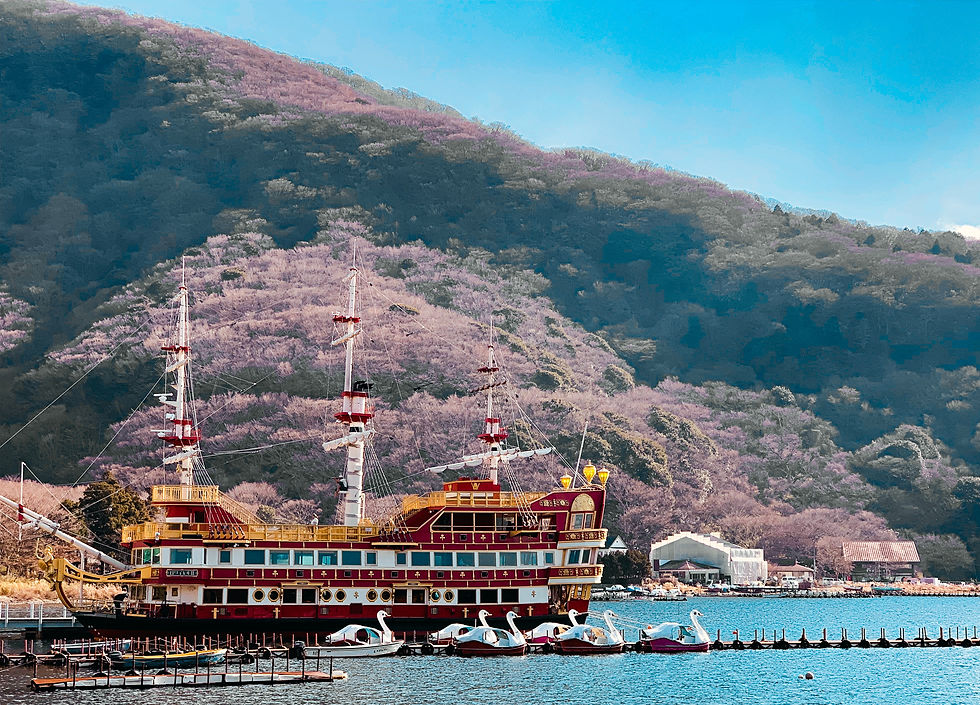
Head back down to Jinja-Dori-Street and walk back along the lake to the sightseeing ship dock (Motohakone-ko). Take the pirate ship cruise up to Togendai Port. You can purchase tickets in advance from Klook. The trip takes around 35 minutes, but there are only 1-2 ships an hour. If you have extra time to spend here (waiting for your ship, for example), there are a couple of things you could do: grab some great views of the lake from the free viewing point or from the Narukawa Art Museum or go and have an amble along the old Tokaido Road. These are all marked on our Hakone map.
Togendai Port to Owakudani
The lakeside terminal for the Hakone Ropeway is right beside the sightseeing cruise port. Your ropeway ticket allows you to get out at the Owakudani Visitor's Centre, where you can sample the famous black eggs, check out the souvenir shop and enjoy the views from the viewing platform. You'll need around 30 mins for this part of the loop, but expect queues for the cable car at peak travel times. Ropeway tickets are also available in advance from Klook.

Owakudani to Gora
Get onto the ropeway again for the rest of the trip up the mountainside to Sounzan Station. If you haven't planned another onsen visit for this trip, you can enjoy a taster of Hakone's hot-spring culture with a quick soak in the free footbath at the station (you'll need to have your own towel with you to dry off). Then take the Tozan cable car up to Gora. The cable car takes around 10 minutes.
Sightseeing & lunch in Gora
Gora is one of the little "villages" in the Hakone area and is home to several attractions as well as plenty of restaurants, so it's the perfect place to have a lunch break. For something very special, Kaiseki Ryori Kadan or Itoh Dining by Nobu are top rated dining options - and luckily lunch is much cheaper than dinner (though you can still expect to pay 12000 yen plus in Kaiseki Ryori Kadan and 6000 yen in Itoh Dining by Nobu). Cheaper but still highly-rated options are the Gora Brewery and Grill, Tamura Ginkatsu Tei and the Gyoza Center. There are loads of little cafés too, though, if you just need a quick snack to keep you going. If you can hold out a little longer, the Open-Air Museum, which is the next stop on the itinerary, has a lovely café and also an all-you-can-eat buffet restaurant (which we found decent).
After (or before) lunch, there are several attractions in the area that you can check out if you have time. Gora Park is a beautifully landscaped garden with a central fountain and is especially famous for its roses (admission around 650 yen but free with the Hakone FreePass, if you have one). We can also really recommend Hakone Museum of Art for its Japanese garden - small but one of the loveliest I've seen.
Gora Station to the Hakone Open-Air Museum
The Hakone Open-Air Museum is just a 15 minute walk from Gora Station or you can hop on the Hakonetozan line to the next stop, Chukokunomori Station. We've been to the Open-Air Museum several times and it has always been a highlight for our family: fun interactive exhibits for kids, beautiful gardens, interesting sculptures, the Picasso museum. Allow at least an hour and a half here.
If it doesn't sound like your thing or if the weather isn't so good that you want to be wandering around outside for an hour or two, the (indoor) world-class Pola Museum of Art is around 20 minutes by bus in the opposite direction from Gora Station, the Hakone Venetian Glass Museum just 6 minutes further and the gorgeous little Sotoshuryukozanchoan Temple just 10 minutes further.
Gora (Open-Air Museum) back to Yumoto/Odawara
By this time, it's likely to be late afternoon and you'll be thinking about heading back to Tokyo. From Gora Station or Chukokunomori Station if you're at the Open-Air Museum, you can take the Hakonetozan Line back to Hakone-Yumoto Station or you can change to bus J04 at Kowakidani Station to go straight back to Odawara Station.
If you still have some time to spare, you could visit a public onsen for an hour or so in Yumoto (for example, Tenseien onsen with its indoor and outdoor baths) or check out Odawara Castle, which is the closest example of traditional Japanese castle architecture to Tokyo and is especially pretty in cherry blossom season.
Hakone day trip from Tokyo: FAQ
Is Hakone worth a day trip from Tokyo?
Hakone is definitely worth a day trip from Tokyo as long as you plan it properly and are realistic about what you can fit into one day. For first-timers in Japan, it's a lovely and authentic introduction to Japanese nature and onsen culture without having to travel too far outside of the city.
Can you do Hakone in one day from Tokyo?
You can't do it ALL but you can certainly see the highlights. Hakone is a relatively short, uncomplicated trip from Tokyo (1-2 hours, depending on which method of transport you take), so leave early in the morning and you'll have plenty of time to do the typical Hakone loop or your own itinerary.
Is the Hakone FreePass worth it for a one-day trip?
The Hakone FreePass is actually designed for a 2-day trip and a 1-day version is not available. However, calculating out the ticket prices for the return trip from Tokyo plus transport within Hakone (including the ropeway, pirate ship, etc.) for our 1-day Hakone loop itinerary, you're likely to at least break even with the Hakone FreePass, so it's probably worth it to save having to buy several separate tickets if nothing else. But remember that the Romancecar is not included in the Hakone FreePass and you'll have to pay extra for a Romancecar reservation (around 1200 yen each way).
Is it better to visit Hakone or Mount Fuji?
In our opinion, a trip to Hakone has more to offer than a trip to Mount Fuji. You can still get lovely views of Mount Fuji from Hakone but there are also beautiful shrines, world-class museums and unique volcanic landscapes to enjoy, whereas the typical Mount Fuji hotspots like Fujikawaguchiko have little to offer the visitor aside from Fuji views - which are elusive at the best of times.
What is the best way to go from Tokyo to Hakone?
The fastest way is by bullet train from Tokyo Station or Shinagawa to Odawara but it's also the most expensive, so it's only worth it if you have a JR regional or all-Japan rail pass. The most convenient way is to take the Odakyu Romancecar, which has all the comfort of the Shinkansen and takes you direct to Hakone-Yumoto.
Need more information for planning your trip to Hakone? Check out our other Hakone posts:
Our hub post is your quick and easy intro guide to Hakone
Wondering if you're going to need a car for Hakone? Our Hakone transportation guide sets out all of the public transport options
With so much to see and do in Hakone, staying overnight is always a good idea but accommodation is very spread out. Our Hakone accommodation guide explains where the best spots to stay are.
Just in case you're undecided: here's why we think a trip to Hakone is definitely worth it but why some visitors may want to save it for next time.
Wondering when to visit Hakone? Our post on the best time to go to Hakone will help you decide.
One of the highlights in Hakone, read our guide to the Hakone Open-Air Museum to decide if you should include a visit on your trip to Hakone
And don't miss our guide to the best things to see and do in Hakone, whatever the season.

Collecting your Japan trip inspo on Pinterest? Hover over and click this pin to save it to your board
Want us to plan a Japan trip just for you? Need help putting together your first trip to Japan? Just get in touch.

Comments