Tokyo cruise port: the complete 2026 guide for Japan cruise passengers

Updated: Sep 27
Disclosure: This post contains affiliate links. If you click through and make a purchase, I may earn a small commission, ♡ at no extra cost to you ♡ It helps cover the costs of keeping this site alive and we really appreciate your support
*Any prices quoted below are subject to change
Tokyo is a relatively new port on cruises stopping in Japan and for cruise passengers lucky enough to dock here directly, it's an amazing port of call. Before we get into logistics, though, there is one important thing to flag: many Japan cruise itineraries list "Tokyo" as a port when the ship is actually docking in Yokohama, thirty kilometres to the south. Yokohama has long served as the gateway port for Tokyo, and a lot of cruise lines simply use the two names interchangeably. If your itinerary says "Tokyo/Yokohama" or lists Yokohama as the disembarkation point, head to our dedicated Yokohama cruise port guide instead. If, on the other hand, your ship really is docking in Tokyo - at the Tokyo International Cruise Terminal - read on, you're in the right place.
Read our Japan cruises guide here for everything you need to know about transport, currency, best cruising seasons, etc. before you book and before you sail. And you'll find every Japanese port of call for 2026/2027 in our Japanese port cities guide here.
The cruise terminals
Tokyo technically has two cruise terminals, though one now handles the large majority of international calls.
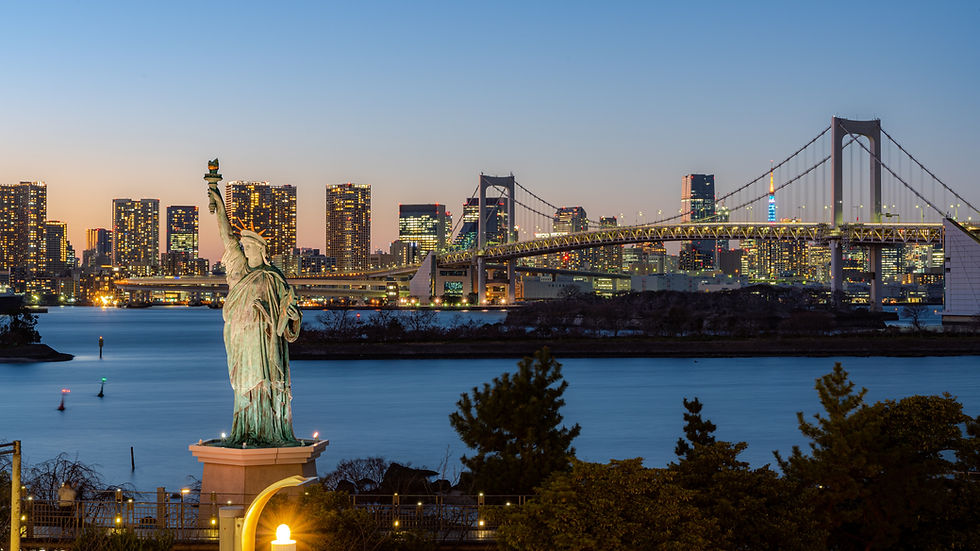
Tokyo International Cruise Terminal (東京国際クルーズターミナル) in the Ariake district of Koto Ward is Tokyo's main cruise facility, having opened in 2020 after a complete redevelopment. Crucially, it has its own dedicated station on the Yurikamome railway line - Tokyo International Cruise Terminal Station - which puts you directly on the public transport network the moment you step off the ship. This makes it one of the more independent-traveller-friendly cruise terminals in Japan. From the terminal, you are a short ride from the Odaiba waterfront district and roughly 30 to 40 minutes from the heart of the city.
Harumi Passenger Ship Terminal (晴海客船ターミナル) in the Harumi district of Chuo Ward is the older facility and now handles a smaller number of calls, primarily from domestic coastal ferries and occasional smaller international vessels. It has no direct train connection, and taxis or buses are the most practical way in and out.
As always, confirm with your cruise line which terminal your ship is using before you plan your day or arrange transfers.
Getting from the airports to the cruise port
As with Yokohama, we strongly advise arriving at least the night before your cruise departs rather than on the day itself, especially if you are flying in from abroad. Tokyo is a vast city, flight delays are unpredictable, and immigration at Narita in particular can be time-consuming.
Haneda is the closest of Tokyo's two airports but there are no direct connections between Haneda airport and the cruise terminal. If you are determined to take public transport directly from the airport to your ship or vice-versa, you'll have to change at least once and your best bet is a combination of a limousine bus (to/from a hotel near Daiba Station, i.e. the Hilton Tokyo Odaiba or the Grand Nikko Tokyo Daiba) and the Yurikamome (between the Cruise Terminal Station and Daiba Station).
Taxis and private transfers are readily available from Haneda and, if you have a lot of luggage or are travelling as a family or group, are often the most practical (and sometimes even cheaper) choice. Journey time is around 40 to 50 minutes in normal traffic. If you are staying the night before in central Tokyo and moving to the ship on embarkation morning, a private transfer to the terminal is worth considering, especially since public transport can be very full. Click the button below to check prices for a private transfer to/from Haneda Airport.
Like Haneda airport, there are no direct connections between Narita airport and Tokyo cruise terminal. Also like Haneda, your best bet is to take a limousine bus to a hotel drop-off point in Daiba and take the Yurikamome from there to the terminal. Narita is around 60 kilometres from central Tokyo and the journey typically takes 60 to 90 minutes by public transport.
Private transfers from Narita to the cruise terminal are expensive compared with public transport, but can represent good value for groups of three or more when you factor in the combined cost of rail tickets plus taxis at the other end - especially if you have significant luggage. Larger vehicles for groups of up to ten or more passengers can also be arranged. Click the button below to check prices for a private transfer to/from Haneda Airport.
Getting from Tokyo cruise terminal into the city
From Tokyo International Cruise Terminal (Ariake): The Yurikamome automated elevated railway from the terminal station is your gateway to the city. It runs through the Odaiba waterfront district and along the Tokyo waterfront to Shimbashi Station, where you can transfer to the JR and Tokyo Metro networks. The full journey from the cruise terminal to Shimbashi takes around 30 minutes and costs approximately ¥400*. From Shimbashi you are extremely well connected: you can walk into Ginza in a few minutes, 15 minutes on the subway or the Yamanote line to Shibuya, and direct services running north, south, east and west across the city.
An alternative is the Rinkai Line, a subway line accessible via a short walk or free shuttle bus to Tokyo Teleport Station (near the terminal). This connects to Osaki on the JR Yamanote Line - Tokyo's main loop line, circling all the major central stations - and can be quicker for destinations to the west and south of the city.
Taxis are available directly from the terminal if you prefer door-to-door convenience. A taxi to Shinjuku or Shibuya will typically cost in the region of ¥4,000 to ¥6,000 depending on traffic, which in Tokyo can vary considerably.
From Harumi Passenger Ship Terminal: There is no train station within practical walking distance. Taxis are the most straightforward option; the journey to central Tokyo takes around 20 to 30 minutes and costs approximately ¥2,000 to ¥3,500. Some cruise lines operating from Harumi provide shuttle buses to nearby transport hubs — check with your cruise line before arrival.
IC cards and day passes: If you are spending any significant time in Tokyo, a Suica or Pasmo IC card is the single most useful thing you can have in your pocket. It works on virtually every train, subway, and bus in the city, on buses throughout greater Tokyo, and at many convenience stores, vending machines, and station kiosks. Even for a single day in port, it saves a lot of time at ticket machines. If you don't already have one, you can pick one up at major train stations including Shimbashi.
What to see and do on a port day in Tokyo
The honest answer is: more than you could see in a week, let alone a day. And there are definitely more highlights than we can list here. The key to making the most of a port day in Tokyo is focus: pick a corner of the city and go deep, rather than trying to race between every famous sight and ending up rushed everywhere - Tokyo is much bigger than you probably think and you can end up criss-crossing the city and spending most of your time on public transport. We have a 3-day Tokyo itinerary that groups the major first-timer attractions roughly by area to save too much travelling around. The itinerary is modular so, even if you're only in the city for a day, you can pick a morning programme from one day and an afternoon programme from another. It also has ideas for rainy days.
Our second tip is to plan your day well in advance and make sure you get your tickets booked as soon as possible - tickets for some of Tokyo's popular attractions sell out in hours.
As we always say, locally operated tours are typically better value than ship shore excursions and almost always more flexible. A knowledgeable guide who knows Tokyo inside out can fit a remarkable amount into a single day - and can take you to places that don't appear on the first page of any guidebook. Browse Viator, GetYourGuide, and Klook for options, and book early: the best guides fill up fast on dates when ships are in town.
Where to stay in Tokyo before or after your cruise
Hotels near Tokyo cruise port
The closest hotels to Tokyo cruise terminal are the Hilton Tokyo Odaiba and Grand Nikko Tokyo Daiba. These are the same two hotels that we pointed out above are stops for the airport limousine buses, so they are a pretty handy overnight option if you're flying in the day before your cruise or leaving early to the airport the next day. Both hotels offer high-end, five-star accommodation with impeccable reviews. Despite the high price tag, their proximity to the cruise terminal means that they regularly book out far in advance during cruise season.
A couple of other options on Odaiba are the Double Tree by Hilton Tokyo Ariake, the Tokyo Bay Ariake Washington and the Sotetsu Grand Fresa Tokyo-Bay Ariake, all within a few minutes walking distance of Ariake and Tokyo Big Sight stations on the Yurikamome and so about 7 minutes from the cruise terminal.
Staying in the city centre
Staying close to the Ariake cruise terminal has the practical advantage of proximity to the ship - but it puts you a train ride away from most of central Tokyo's sightseeing. For most passengers, especially those of you staying in Tokyo for more than just one night before or after your cruise, we would recommend prioritising a central Tokyo location over terminal proximity. The Yurikamome connection means the journey to the ship on embarkation morning is very manageable even with luggage.
To help you decide where to stay, we have a post on what we think are the best areas and districts in Tokyo. We're big fans of the Ginza area (and give you 6 good reasons why Ginza is a great neighbourhood to stay in). For cruise passengers, Ginza has the added advantage of having a Yurikamome station (Shimbashi) right on the door step. Click on the map below to check availability and prices.
Day trips from Tokyo
If you've been in Tokyo before or are spending a day or two there pre- or post-cruise, you want might to venture further afield, and there are some really great day trips you could consider. Here are some of our favourite spots:

Kamakura is gorgeous. This ancient coastal city served as Japan's political capital in the 12th and 13th centuries and retains a marvellous collection of Zen temples, Shinto shrines, and forested hiking trails. The Great Buddha at Kotoku-in Temple - a 13-metre bronze figure seated serenely in the open air - is one of Japan's most iconic sights. The charming Enoden tram line connects the main attractions and is a joy in itself. Kamakura is an easy 1-hour train journey from Tokyo but the town itself is a bit spread out along the coast. If you have time enough to spare, you can go it alone. If you've got to be back for all-aboard, we'd recommend taking an organised tour.

Hakone is famous for its volcanic scenery, hot spring ryokan, and postcard-perfect views of Mount Fuji across Lake Ashi. The town is around 85 minutes from Shinjuku by the Odakyu Romancecar express service, but again, the sights are spread out around the lake and involve some travelling in between. The Hakone Free Pass from Odakyu covers most transport within the area and discounts at around 70 attractions. An organised tour combining Hakone and Mount Fuji is a great, comfortable option if you would rather not worry about navigation.

Nikko is a spectacular and slightly underrated alternative for those who have already done Kamakura and Hakone. Around two hours from Asakusa Station on the Tobu Nikko Line, Nikko is home to the extravagantly ornate Tosho-gu Shrine complex - a World Heritage Site that is arguably the most elaborately decorated building in Japan - alongside sacred waterfalls and beautiful mountain scenery. It sees significantly fewer foreign visitors than Kamakura and is all the better for it. Getting there is relatively straightforward but the famous waterfall is outside town and requires and extra journey.

Kyoto is an absolute must-see for visitors to Japan, of course, and if your only Japanese port is Tokyo, you might be asking yourself if Kyoto would be possible as a day trip. And it is: the shinkansen takes only 2 hours 15 mins from Tokyo to Kyoto. But you have to remember that that's 5 hours out of your day right there. Kyoto's transport system is also notoriously slow, since you're relying on buses most of the time. If you are determined to go to Kyoto, leave Tokyo as early as possible, plan your Kyoto itinerary carefully and pick just two or three highlights - you definitely won't be able to fit much more in.
Tokyo cruise port: FAQ
Is the Tokyo cruise port the same as Yokohama? No - they are separate ports approximately 30 kilometres apart. However, many Japan cruise itineraries list "Tokyo" when the ship actually docks at Yokohama, which has long served as the gateway port for the capital. Check your boarding documents carefully. If your itinerary says Yokohama, our dedicated Yokohama cruise port guide is what you need.
Where is the cruise terminal in Tokyo? The main cruise facility is the Tokyo International Cruise Terminal in the Ariake district of Koto Ward, on the waterfront east of central Tokyo. It has its own dedicated Yurikamome train station. An older terminal at Harumi in Chuo Ward handles a smaller number of calls.
How do I get from Tokyo International Cruise Terminal to central Tokyo? The Yurikamome automated railway from the terminal station runs to Shimbashi in around 30 minutes (approximately ¥400*), from where you can connect to the JR and Metro networks for the rest of the city. The Rinkai Line, accessible via a short walk or shuttle bus to Tokyo Teleport Station, also connects to the Yamanote Line at Osaki.
How far is the Tokyo cruise terminal from Shinjuku? Allow around 45 to 55 minutes by train (Yurikamome to Shimbashi, then JR to Shinjuku). A taxi will take 40 to 60 minutes depending on traffic and cost in the region of ¥4,000 to ¥6,000.
What is the best area to stay before or after a cruise from Tokyo? We think Ginza is a great area to stay in, especially before or after a cruise, because it's very central in Tokyo with lots to see and do but, more importantly, it has excellent train and subway connections, including a Yurikamome station with a direct route to the Tokyo International Cruise Terminal.
What is the best tour from Tokyo cruise port? It depends on your time in port and what you have already seen. First-time visitors to Japan should prioritise Tokyo itself — a guided tour covering Asakusa, Shibuya, and Shinjuku makes for a spectacular introduction to the city. Those who have already explored central Tokyo might prefer a day trip to Kamakura, Hakone, or Nikko. Always check your time in port before booking: a six-hour call realistically gives you four to five hours in the city after transit time.
Can I visit Kyoto on a day trip from Tokyo cruise port? Technically yes, but we would not recommend it unless your ship is in port from very early morning until late evening. The return journey by Shinkansen takes around four and a half hours in total, leaving precious little time in Kyoto itself. Kamakura, Nikko, and Hakone are all far more practical day trips. Save Kyoto for a dedicated multi-night stay if you can.

Have a look at the other posts in our Japan cruise hub: Kobe cruise port guide, Yokohama cruise port guide, ultimate guide to all Japan cruise ports and everything you need to know about Japan cruises!
Saving all your Japan cruise inspiration on Pinterest? Hover over the pic to pin this post to your Japan cruise board!


Comments