Kabukicho: is it worth visiting in 2026?

Updated: Sep 27

Tokyo's most famous entertainment district is wilder, weirder, and more fun than you'd ever imagine - and yes, there's a giant Godzilla
Prepare to have your eyeballs absolutely assaulted - in the best possible way. Kabukicho (歌舞伎町) is Tokyo's largest and most famous entertainment district, a pulsating, neon-drenched labyrinth tucked into the heart of Shinjuku that truly defies description. Temples and tranquil gardens, this is not. Kabukicho is where Tokyo lets its hair down completely, and the result is one of the most exhilarating urban spectacles on the planet. But the district has been getting a bad rap of late, so is it still worth visiting? Here's our take.
Disclosure: This post contains affiliate links. If you click through and make a purchase, I may earn a small commission, ♡ at no extra cost to you ♡ It helps cover the costs of keeping this site alive and we really appreciate your support
*Any prices quoted below are as of May 2026 and are subject to change
Whether you're here for the legendary nightlife, the towering arcades, the themed restaurants, or simply to gawp at the sheer sensory overload of it all, Kabukicho Shinjuku delivers every single time. Just watch out for the giant lizard.
What is Kabukicho?
Kabukicho is Tokyo's premier entertainment and nightlife hub, and has been since the post-war era. It sits just northeast of Shinjuku Station's East Exit, which makes it fabulously easy to reach from almost anywhere in the city.
The district covers several city blocks and is layered with restaurants, bars, karaoke chains, arcades, cinemas, love hotels, host and hostess clubs, and everything in between. Yes, it does have a reputation as a red-light district - we look at how safe Kabukicho is in another post - but that's only one facet of an enormous, endlessly varied neighbourhood that attracts millions of entirely mainstream visitors every year.
Getting there: where is Kabukicho?
Kabukicho is super-accessible, practically spilling out of one of the world's busiest train stations.
Nearest station: The easiest way to reach Kabukicho is via Shinjuku Station (新宿駅), particularly its East Exit. Shinjuku Station is a massive hub for multiple JR lines (Yamanote Line, Chuo Line, Saikyo Line, Shonan-Shinjuku Line) and numerous Tokyo Metro and private subway lines (Marunouchi Line, Shinjuku Line, Oedo Line). You can also easily walk from Shinjuku-sanchome Station (新宿三丁目駅) on the Tokyo Metro Marunouchi, Fukutoshin, and Toei Shinjuku Lines.
By taxi: A taxi will drop you off right at the entrance of Kabukicho or near your chosen venue.
Accessibility: Kabukicho features wide, flat streets that are generally easy to walk on. However, due to the extremely high volume of pedestrians, especially at night, it can become very crowded. Navigating with strollers or wheelchairs might be challenging during peak hours.
Opening hours & best time to visit Kabukicho
Technically, Kabukicho never closes. Convenience stores, certain restaurants, and other establishments operate around the clock, and the streets themselves are always there to wander through.
That said, the real Kabukicho - the neon-blazing, crowd-surging, slightly unreal version - kicks into gear from early evening and keeps going until well past the last train.
Early evening (6 PM – 9 PM): The sweet spot for most visitors. The lights are on, the streets are buzzing, and the energy is electric without things getting too intense. Great for photos, dinner, and a first drink.
Late night (after midnight): The atmosphere shifts. Touts become more persistent, the adult entertainment element becomes more prominent, and it's simply less comfortable for solo travellers or anyone unfamiliar with how to handle unwanted attention. Not dangerous — just less pleasant. Read more in our Is Kabukicho Safe? guide.
Avoid Kabukicho in the early morning - it's like the worst hangover ever, utterly depressing and usually filthy.
Reservations & admission
Walking into Kabukicho costs absolutely nothing. The streets are public, the spectacle is free, and you can spend hours here without spending a single yen - though you almost certainly won't want to.
Individual venues set their own prices, hours, and reservation policies. For restaurants and themed bars, booking in advance is often a good idea, especially on weekends. Smaller bars in Golden Gai are generally walk-in only.
Payment: Most larger establishments — arcades, karaoke chains, restaurants — accept credit cards and IC cards (Suica/Pasmo). Smaller bars, particularly in Golden Gai, are frequently cash-only. Always keep some yen on you.
What is there to see & do in Kabukicho?
The neon spectacle itself
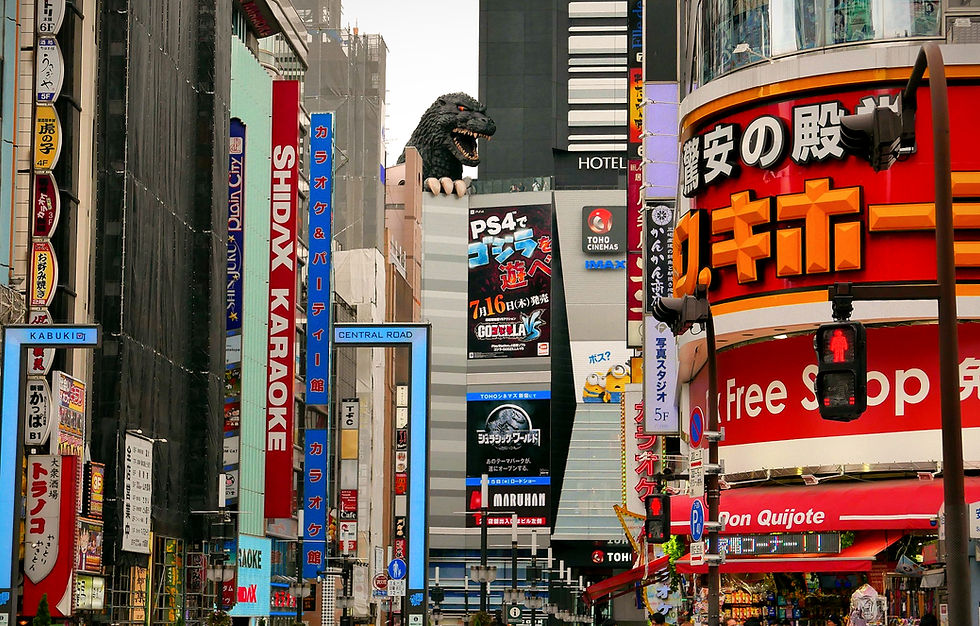
Walking under the iconic Kabukicho Ichiban-gai arch and into the main drag is an experience in itself. Buildings stacked floor-to-ceiling with enormous illuminated signs in every colour imaginable, throngs of people, touts calling out, music spilling from open doors - it is absolutely, overwhelmingly alive. Budget time to simply walk, look up, and take it all in. You can get a get view and iconic photos of the famous red Kabukicho sign and of Godzilla street from the central reservation of Yasukuni-dori Avenue.
Perched on the roof of the Shinjuku Toho Building (home to Toho Cinemas) is a life-sized Godzilla head that periodically roars and emits steam on a timed schedule. It's tremendous fun, completely ridiculous, and one of the best free photo opportunities in all of Tokyo. Check the schedule when you arrive - the timings vary. It used to be possible to go out onto the terrace at the Gracery Hotel and get up close and personal with Godzilla, but not anymore, thanks to tourists putting themselves and others in danger. But the hotel still has fab Godzilla views from the lounge and has special Godzilla-themed and Godzilla-view rooms.
Just off the main strip lies Golden Gai: a dense cluster of tiny, ramshackle bars connected by narrow alleys that feel like they've been frozen in the 1960s. Each bar holds maybe six to eight people, is usually run by a single charismatic owner, and has its own micro-identity — some literary, some cinephile, some simply eccentric. It's one of Tokyo's most atmospheric and unique drinking experiences, and a complete contrast to the glitz just a few metres away.
Just west of Shinjuku Station, Omoide Yokocho is a narrow alley packed with tiny yakitori stalls, smoke drifting into the night air, salarymen perched on stools nursing cold beers. It's wonderfully nostalgic and sits at the opposite end of the mood spectrum from Kabukicho. A great spot for dinner before or after your Kabukicho wander.
Arcades
Kabukicho and its immediate surroundings are home to multi-storey arcades — Taito Station and various SEGA branches among them — packed with crane games, rhythm games, photo booth machines (purikura), and classic arcade cabinets. You can easily lose an hour (and a decent chunk of yen) without noticing.
Karaoke
Karaoke in Japan is the private-room variety, which makes it infinitely less terrifying than the Western open-mic version. Chains like Karaoke Kan and Big Echo have locations in and around Kabukicho. Grab a room with friends, order drinks to the room, and sing until the last train.
Restaurants & bars
The range here is staggering. Cheap ramen, elaborate themed restaurants, izakayas at every price point, late-night gyoza spots, high-end cocktail bars — it's all here. Wander until something catches your eye; that's genuinely the best strategy.
Host & hostess clubs / love hotels:
These are prominent features of Kabukicho's landscape. While fascinating to observe from the outside (especially their elaborate signage), it's generally not recommended for tourists to enter these types of establishments without a trusted local guide and a clear understanding of the potentially high costs and specific etiquette involved.
Japansophy’s top tips!
Go with friends (especially at night): Kabukicho is exciting, but it's always safer and more fun to explore it with companions. GetYourGuide has a lot of great tours of the area so check them out of you would like to have a local guide you around to all the best bars and restaurants without having to fear for your wallet.
Stick to reputable spots: If approached by touts offering "special deals" for bars or clubs, it's generally best to politely decline and stick to well-known establishments or places recommended by your hotel. Kabukicho is safe but stay aware and don't take any chances.
Have your passport ready: If you plan to drink alcohol, remember the legal drinking age in Japan is 20, and bars/restaurants may ask for ID.
Hotels in Kabukicho
We wouldn't necessarily recommend staying in Kabukicho. While it's a great place to visit at night, we generally recommend staying in quieter parts of Shinjuku or, to be honest, other districts in Tokyo altogether. But we can appreciate that some travellers want to be right in the action, in which case you should look at booking a reputable hotel. Two of the best are the Shinjuku Prince (right at the station, but the standard rooms are pretty small for the money; see if you can get the higher floors - the views are superb) and the Hotel Gracery, of Godzilla head fame. On the cheaper in of the scale, the APA chain has the Shinjuku Kabukicho Tower (the cheapest rooms are absolutely tiny and the next size up are little less than the Gracery or Shinjuku Prince; a bit further away from the station, too) and the Kabukicho Chuo (not far from the Gracery; typical of APA, though, the rooms are minute).
Facilities
Kabukicho has no shortage of places to eat, drink, and find facilities.
Eating & drinking: You are absolutely spoiled for choice! From tiny ramen shops and yakitori stalls to large restaurants and international dining options, there's food for every taste and budget. Countless bars, pubs, and karaoke places offer endless drinking opportunities. You can easily grab snacks or drinks from any of the numerous convenience stores.
Toilets: Public restrooms are generally located within larger entertainment complexes, department stores, or individual establishments. While most are clean and presentable, cleanliness can vary in some smaller venues.
Baby-changing facilities: Dedicated baby-changing facilities are generally found in larger complexes like cinemas, department stores near Shinjuku Station, or major restaurants, rather than in the smaller, independent bars and eateries within Kabukicho itself.
Other attractions nearby: check out some of our other Shinjuku guides
Kabukicho's central location means you're perfectly placed to explore other parts of Shinjuku.
Omoide Yokocho: Just a short walk to the west of Shinjuku Station, this nostalgic alleyway offers a contrasting traditional izakaya experience.
Golden Gai: Another famously atmospheric (and even tinier!) drinking district, known for its unique, themed micro-bars, often run by quirky owners.
Shinjuku Gyoen National Garden: For a complete change of pace, this expansive and beautiful garden offers tranquil Japanese, French, and English landscapes.
Tokyo Metropolitan Government Building: Head here for a spectacular free panoramic view of Tokyo from its observation decks, perfect for seeing the city lights you just experienced from above.
Ready to dive into Tokyo's most vibrant and unforgettable nightlife? Our 3-Day Tokyo Itinerary guides you through the energy of Kabukicho and helps you discover Shinjuku's diverse offerings!


Comments