Travelling in Japan at Christmas and New Year: what to expect for your year-end trip

Updated: Jan 10
Are you planning to spend the last week or two of the year in Japan? Whether you’re dreaming of romantic illuminations or wondering if you’ll actually be able to find dinner on 1st January, here is everything you need to know about navigating the holiday season in Japan.
Jump to:
Christmas in Japan – hot fried chicken and hot dates!
The first thing to know about Christmas in Japan is that it isn’t a public holiday. 25th December is a normal working day for most. Schools are often still in session, and the "holiday spirit" is purely atmospheric rather than religious. Shops will be decorated, there will be Santas a-plenty and don't think that you'll be able to escape "Jingle Bells" and "Last Christmas" just by taking a trip to Japan. But that's as deep as it goes: in Japan, Christmas is little more than Halloween with a different colour-theme.
A few home-bred traditions have grown up in Japan around the holiday season, though:
The romantic date night: Christmas Eve is the big event. High-end restaurants and hotels are booked months in advance by couples. If you want a nice dinner on the 24th, book your table nice and early!
The KFC Phenomenon: It sounds like a myth, but it’s 100% real. Thanks to a brilliant 1970s marketing campaign, millions of Japanese families eat Kentucky Fried Chicken for Christmas dinner. You actually have to pre-order "Party Barrels" weeks in advance.
Strawberry Shortcake: The dessert of choice is a "Christmas Cake"—typically a light sponge cake with whipped cream and fresh strawberries (matching the red and white of the Japanese flag, not to mention Santa's hat).
New Year in Japan - the real holiday
Move over Christmas: New Year is the main deal in Japan. But if you're expecting big parties and massive fireworks à la New York, Rio, Sydney or Dubai, you might end up sorely disappointed. New Year, or Oshogatsu, tends to be a much quieter, reflective, religious and family-oriented holiday in Japan. Which is not to say that you won't be able to find that party and dance in the new year with abandon... but you'll have to look a little harder and don't be surprised if things wind down very early (like before 1am!). There are a few fireworks events here and there (namely in Yokohama and Yokosuka, where there is a large US presence), but not on the scale of the dazzling displays you'll see in summer.
Travelling in Japan at Christmas and New Year: what to see and do
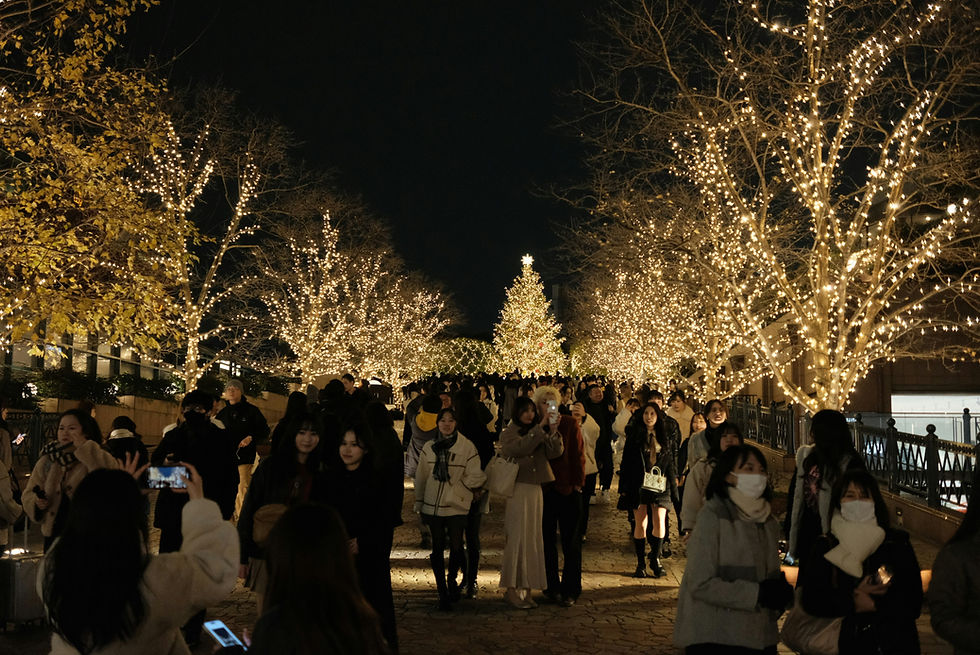
The real highlight for tourists at this time of year is the winter illuminations. Japanese cities go all out with millions of LED lights. Most of these go up after Halloween and some stay up until February. Some have paid entry and others are free for you to just wander around.

Top spots for winter illuminations
Tokyo: Yomiuriland, Ao no Dokutsu in Shibuya, Keyakizaka street in Roppongi, Oi Race Course
Elsewhere: Huis ten Bosch, Nagasaki; Kobe, Hyogo; Ashikaga Flower Park, Tochigi; Sapporo, Hokkaido
Hatsumode
Hatsumode is the first visit of the year to the local temple or shrine to pray for health and good fortune for the coming year. Families usually do this together on the 1st of January or the first few days of January. Or you might want to visit a temple around midnight to hear the bell being rung 108 times as a purification ritual (joya no kane). You might even get to participate in the bell-ringing at some temples.
New Year delicacies

If you're in Japan at the end of the old year and the beginning of the new one, you might want to try some of the seasonal treats that are traditional fare for New Year. Toshi-koshi soba (year-crossing-over buckwheat noodles) is a very popular dish eaten on 31st December. The long noodles symbolise a long, healthy life. Mochi are another traditional New Year's treat, but are usually eaten in a soup rather in the sweetened form you might be more familiar with.
Since a lot of restaurants are closed for a day or two at the beginning of January, many families order osechi ryori, which looks a little like a very elaborate o-bento and is designed to save cooking over the holiday period. The foods included in the osechi ryori symbolise luck, posterity, health and long life.
What you need to think about if travelling to Japan at Christmas and/or New Year
If you are thinking of planning a trip to Japan for the end of the year or the first week of January, there are a few things you need to keep in mind. First of all, if you are used to a very festive Christmas season, if Christmas is spiritually significant for you or if you enjoy a big blow-out on New Year, you might find a trip to Japan at this time of year a bit of a let-down. As mentioned above, Christmas is a normal working day in Japan and for the most part you will have to make your own festivities. Ideal, though, for grinches everywhere! In contrast, New Year is one of the biggest holidays in the Japanese calendar, but families tend to spend it quietly at home or visiting the local temple or shrine at the most. Which brings us to the biggest hurdles you will face when travelling to or around Japan at this time of year. In the first place, many restaurants, shops and other facilities such as museums will be closed on 1 January and in some cases on the next few days too. There are exceptions: combinis are open all year round, so you won't starve, and theme parks like Disneyland are open on the 1st. Nevertheless, you should plan your itinerary with this in mind. Secondly, transportation could be a problem. Not only will a limited timetable be in operation on the 1st of January, but long-distance transportation (shinkansen, planes) will be very full and potentially booked out on the days leading up to and following New Year, as families travel around to unite with their loved ones for the holiday. Keep the above points in mind especially if you intend to stay outside of the major cities: the more off-the-beaten-track you are, the more you will have to deal with closures and a lack of transport options.
FAQ: Christmas and New Year in Japan
(1) Does Japan do anything special for Christmas?
Not really, to be honest. Japan is not a Christian country and doesn't have a long tradition of celebrating Christmas. The 24th and 25th December are normal working days. Many cities have beautiful winter illuminations, which are a real attraction, and the 24th is only second to 14th February for romantic dates.
(2) Does Japan celebrate Christmas with KFC?
KFC came up with a very clever advertising campaign back in the 1970s and has since become associated with Christmas Day. They have special menu items for Christmas, which have to be ordered in advance and sell out very quickly.
(3) Is 2nd January a holiday in Japan?
January 2nd is not an official national holiday in Japan but many businesses, shops, restaurants and other facilities will remain closed on this day too. You should take this into consideration when planning your trip: you may not be as mobile or find as many things open on 2nd January as you otherwise would.
(4) Is it worth going to Japan for new year's?
It depends very much on what you expect and want to spend the holiday. Unlike New York or Rio or Sydney that have becomes synonymous with big New Year countdowns, parties, fireworks, public celebrations, New Year in Japan is quiet, in part religious and mostly spent at home with the family. Bringing in the new year in Japan can be beautifully atmospheric, reflective and a true cultural experience, which might be exactly what you want.
Have you spent Christmas or New Year in Japan? What was your experience? Let us know in the comments.


Comments