Is Kabukicho safe? Everything you need to know before you visit

Updated: Sep 27

Disclosure: This post contains affiliate links. If you click through and make a purchase, I may earn a small commission, ♡ at no extra cost to you ♡ It helps cover the costs of keeping this site alive and we really appreciate your support
*Any prices quoted below are subject to change
Tokyo's most notorious district has a reputation that is both earned and significantly overstated. Here's the honest picture.
Before I flew to Japan for the first time ever, my Japanese professor took me to one side and told me to avoid Shinjuku-Kabukicho at all costs. "Red-light district." "Yakuza territory." "Tokyo's seedy underbelly." Mind you, he also told me I didn't have to worry about earthquakes in Kobe, where I was going to live, and the Great Hanshin-Awaji Earthquake struck a few months later, so...
Is Kabukicho safe to visit? My honest answer is: yes, for the vast majority of visitors, Kabukicho is perfectly safe. But there are things worth knowing before you go.
Is Kabukicho safe: the short answer
Kabukicho is safe to visit. Tokyo consistently ranks among the safest major cities in the world, and that safety extends to Kabukicho. Millions of tourists, locals, and families pass through this district every year without incident. Violent crime is rare, and the kind of street danger that characterises red-light districts in many other countries is largely absent here.
That said, Kabukicho does have edges worth understanding — particularly at night, and particularly for solo travellers. Knowing what to expect means you can enjoy the experience without being caught off guard.
Is Kabukicho a red-light district?
Kabukicho is officially classified as an entertainment district. It is home to an enormous range of entirely mainstream attractions: restaurants, bars, arcades, karaoke boxes, cinemas, and some of Tokyo's most atmospheric drinking alleys. These are what most visitors come for, and they account for the majority of what's on offer.
However, Kabukicho is also home to host and hostess clubs, love hotels, and establishments offering adult services — the industries that earn it the "red-light district" label. These are legal in Japan, regulated, and operate openly. Their signage is often elaborate and sometimes surreal, and they're very visible as you walk through the district.
The key difference from red-light districts in many Western cities is that in Kabukicho, these establishments exist alongside — rather than instead of — mainstream entertainment. They occupy the same streets as ramen shops and family-friendly arcades. The district is not segregated by use. This can feel surprising at first, but it doesn't make the area threatening or dangerous.
Is there still a Yakuza presence in Kabukicho?
Kabukicho does have a historical association with organised crime. For much of the 20th century, various yakuza groups had interests in the district's entertainment businesses. However, a major police crackdown throughout the 2000s and 2010s significantly reduced that presence, and the district today is heavily policed and monitored.
You are extremely unlikely to have any meaningful encounter with organised crime as a tourist in Kabukicho, or anywhere else in Japan for that matter. The occasional tout you might encounter on the street is a far more prosaic concern — and a very manageable one (more on that below).
What to be aware of in Kabukicho
Touts
The most common unwanted interaction in Tokyo-Kabukicho is with touts — people on the street offering deals on bars, clubs, or restaurants. This is by far the biggest irritant in the district, and while it's rarely aggressive, it can become tiresome. And to be honest, the touts aren't limited to Kabukicho: we've been approached, too, on the streets of Shibuya and even in Takeshita Street in Harajuku.
It's always the same deal: someone (often a young guy, often in smart-casual clothing) will approach you with a laminated menu or printed offer, usually for a bar or club with "very cheap drinks" or a "special price for tourists." A lot of the touts these days are foreigners themselves, hired for their language abilities and outgoing, confident personalities.
What they don't tell you: these establishments often have hidden charges — seating fees, service charges, mandatory food orders — that can make a "cheap drink" unexpectedly expensive. In more extreme cases, tourists have reported bills significantly higher than expected, with pressure to pay.
How to shake them off: A polite but firm "no thank you" and continued walking is sufficient in almost all cases. Do not take the menu. Do not engage beyond a brief refusal. If someone becomes persistent, stepping into a convenience store or nearby restaurant is a reliable way to lose them.
The late-night atmosphere in Kabukicho
Kabukicho at 10 PM and Kabukicho at 1 AM are two very different experiences. As the night progresses, the mainstream restaurants close, the volume of street touts increases, and the atmosphere shifts toward the district's more adult-orientated offerings.
This doesn't make it dangerous, but it does make it less comfortable for solo visitors, first-timers, or anyone unfamiliar with the environment. The sweet spot for most visitors is the early evening — roughly 6 PM to 10 PM — when the neon is blazing, the streets are busy with all kinds of people, and everything is at its most accessible and enjoyable. Luckily, it gets dark early in Japan, even in summer, so you can experience the literally bright lights of Kabukicho and still be back safe and sound in your hotel room before the real night owls come out to party.
Host and hostess clubs
These deserve a specific mention. Host clubs (catering to women) and hostess clubs (catering to men) are legal businesses where customers pay for the company of attractive, attentive staff, along with drinks and conversation. They are a legitimate part of Kabukicho's economy and a genuinely fascinating cultural phenomenon.
However, they are not designed for casual tourist drop-ins. Costs can be opaque and escalate quickly, the etiquette is specific, and misunderstandings can be stressful and expensive. As a tourist, you're well advised to stay away without a trusted local guide who knows the establishment and can navigate the experience with you. If you're worried about wandering into the wrong kinda place, check out some of the Kabukicho tours available on GetYourGuide:
Is Kabukicho safe for solo female travellers?
Generally yes, with the usual caveats of any busy nightlife district anywhere in the world.
Street harassment in Tokyo is significantly lower than in many comparable cities globally. However, solo female visitors in Kabukicho — particularly late at night — may receive more attention from touts and, at the more adult-orientated end of the district, some unwanted overtures.
The practical advice is the same as for anyone: visit in the earlier evening, don't engage with street touts, stick to well-lit main streets rather than darker side alleys at night, and trust your instincts. If something feels off, leave.
Kabukicho has a visible police presence, and the Kabukicho Police Box (koban) near the main entrance is staffed and accessible if you need assistance.
Is Kabukicho safe for families and children?
During the daytime and early evening, yes — with the understanding that it is an adult entertainment district with visible signage reflecting that. Older children and teenagers are fine; the area isn't dangerous. But the signage for love hotels and adult clubs is explicit enough that parents of younger children may prefer to explore other parts of Shinjuku or at least be prepared to answer some tricky questions.
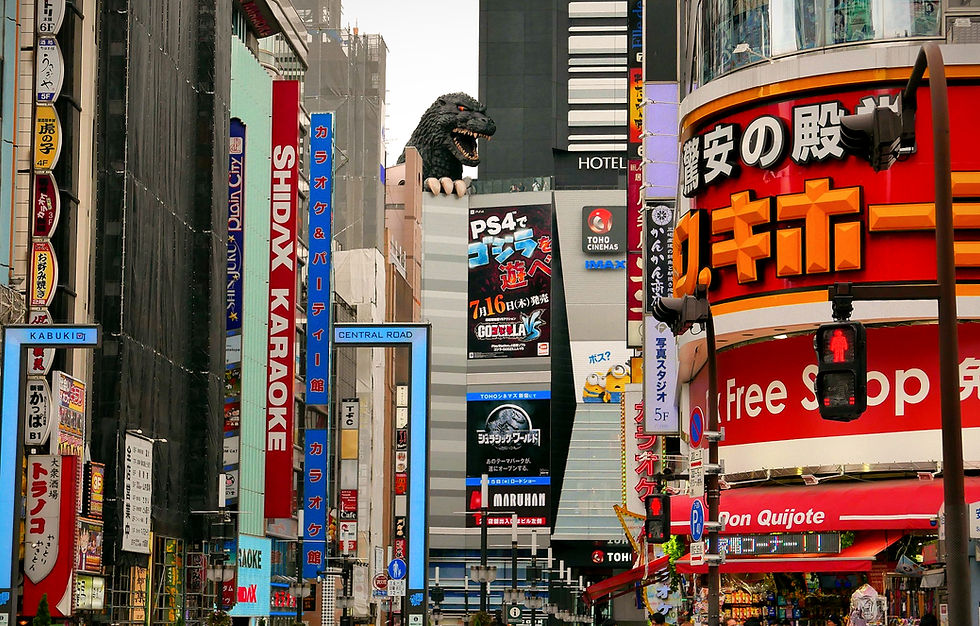
If you're bringing kids, the early evening window (6 PM – 8 PM) is the most family-appropriate. They'll get a kick out of the Godzilla head at the Toho Cinemas building and this is about as neon as it gets in Tokyo. Like I said above, we've had our own kids here several times, but always just for a walk around and to say hi to the "dinosaur".
Should I book a hotel in Kabukicho?
Kabukicho is waaaaaay down our list of good places to stay in Tokyo to be honest. When all's said and done, it suffers in a comparison with cleaner, quieter, cheaper, more sanitary areas. But aside from that, if you stay in this area, you're going to have to use Shinjuku Station at least twice a day and I see no reason to do that to myself or my family. If you're really determined to stay in Kabukicho - each very much to their own - there are some very decent hotels in the area. Two of the best are the Shinjuku Prince (right at the station, but the standard rooms are pretty small for the money; see if you can get the higher floors - the views are superb) and the Hotel Gracery, of Godzilla head fame. On the cheaper in of the scale, the APA chain has the Shinjuku Kabukicho Tower (the cheapest rooms are absolutely tiny and the next size up are little less than the Gracery or Shinjuku Prince; a bit further away from the station, too) and the Kabukicho Chuo (not far from the Gracery; typical of APA, though, the rooms are minute).
Otherwise, have a look at our guide to our favourite places to stay in Tokyo.
Our honest verdict
Kabukicho is not the dangerous den of iniquity its reputation sometimes suggests. It is a busy, boisterous, genuinely exciting entertainment district with a visible adult industry running alongside its mainstream offerings. For the vast majority of visitors — tourists, groups, couples, solo travellers exercising basic awareness — we have never felt in any way endangered here and we've had more trouble with touts outside Marion Crepe in Harujuku.
That said, we personally would never dream of staying in this part of Tokyo and we like to be in and out again at an early hour while there are still plenty of other tourists and families around. We, too, have seen the recent reports of the growing problem of young people getting into all sorts of trouble in this district: alcohol and substance abuse, sex-work and sleeping on the streets (the so-called Toyoko kids). And as pristine as Tokyo's streets are compared to other big cities around the world, Kabukicho is getting quite the reputation for being dirty and vermin-infested. Not something you want to be walking up to in the morning.
Want the full guide to what to see, do, and eat in Kabukicho? Head to our main Kabukicho Tokyo guide for everything you need to plan your visit.

Collecting your Japan trip inspo on Pinterest? Hover over and click this pin to save it to your board
Want us to plan a Japan trip just for you? Need help putting together your first trip to Japan? Just get in touch.

Comments